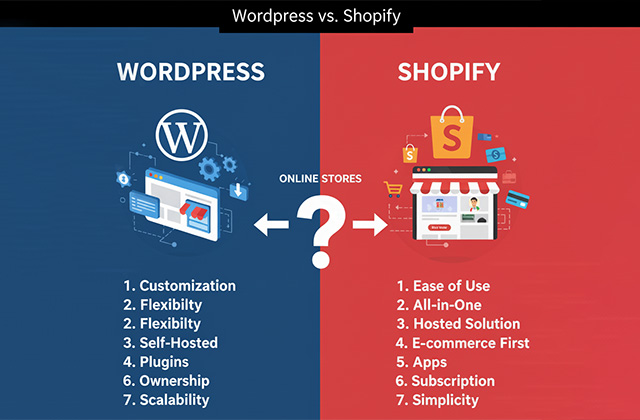
When starting an online store, the first big decision is choosing the right platform. Two of the most popular choices are WordPress (with WooCommerce) and Shopify.
Both platforms power millions of eCommerce sites worldwide, but they serve different types of business needs. In this guide, we’ll break down the 7 key differences between WordPress and Shopify so you can decide which one is best for your online store.
1. Ease of Use
Shopify: Extremely beginner-friendly. You can launch a store in hours with no coding required.
WordPress (WooCommerce): Offers more control but comes with a steeper learning curve. Requires setup, hosting, and some technical knowledge.
✅ Winner: Shopify for beginners, WordPress for tech-savvy users.
2. Pricing Structure
Shopify: Fixed monthly plans (starting at $39/month). Additional app costs can increase expenses.
WordPress: Hosting ($5–$30/month), domain ($10/year), and optional premium themes/plugins. More variable but often cheaper long-term.
✅ Winner: WordPress for flexibility in cost, Shopify for predictable pricing.
3. Customization & Flexibility
Shopify: Limited customization, mostly app-based. Great for standard eCommerce needs.
WordPress: Unlimited customization with 59,000+ plugins and thousands of themes. Perfect for unique or advanced functionality.
✅ Winner: WordPress offers unmatched flexibility.
4. SEO & Marketing Tools
Shopify: Built-in SEO tools and marketing integrations. Easy but limited control.
WordPress: Advanced SEO with plugins like RankMath and Yoast. Better for content-driven businesses.
✅ Winner: WordPress dominates SEO.
5. Payment Options & Fees
Shopify: Supports multiple gateways but adds transaction fees unless using Shopify Payments.
WordPress: Works with PayPal, Stripe, Razorpay, and more—no extra platform fees.
✅ Winner: WordPress provides more freedom and lower costs.
6. Scalability & Growth
Shopify: Scales quickly, but costs increase as you grow.
WordPress: Scales with the right hosting and developer support, often at lower long-term costs.
✅ Winner: Both scale well, but WordPress gives more control over scaling costs.
7. Security & Maintenance
Shopify: Fully managed security (SSL, PCI compliance, server updates). Hands-off for the user.
WordPress: Security depends on hosting and plugins. Requires active maintenance but allows full control.
✅ Winner: Shopify for hassle-free security, WordPress for flexibility.
Both WordPress and Shopify are excellent choices, but the right platform depends on your business goals:
Choose Shopify if you want a beginner-friendly, ready-to-launch store with minimal setup.
Choose WordPress (WooCommerce) if you want full control, customization, and SEO power for long-term growth.
👉 Pro Tip: Many businesses start on Shopify for simplicity and later migrate to WordPress as they expand and need more advanced features.
FAQs
1. Is WordPress better than Shopify for beginners?
Shopify is easier for beginners. WordPress is better if you want more control.
2. Which is more cost-effective?
WordPress can be cheaper long-term, while Shopify offers predictable monthly pricing.
3. Which platform is better for SEO?
WordPress wins with advanced SEO plugins and blogging flexibility.
4. Can I switch later?
Yes, you can migrate from Shopify to WordPress or vice versa with the right tools.
Looking to build your WordPress or Shopify store? 🚀 I help businesses worldwide create stunning, scalable, and SEO-optimized eCommerce websites.